The latest release in the “Design for Children” series by Tongji University Press, Child-Friendly Practical Cases in China (Volume One), is designed to compile and disseminate a range of successful child-friendly practice cases, offering readers a holistic and well-rounded perspective on child-friendly living. The aim is to provide valuable insights and references to support the development of child-friendly cities in China.
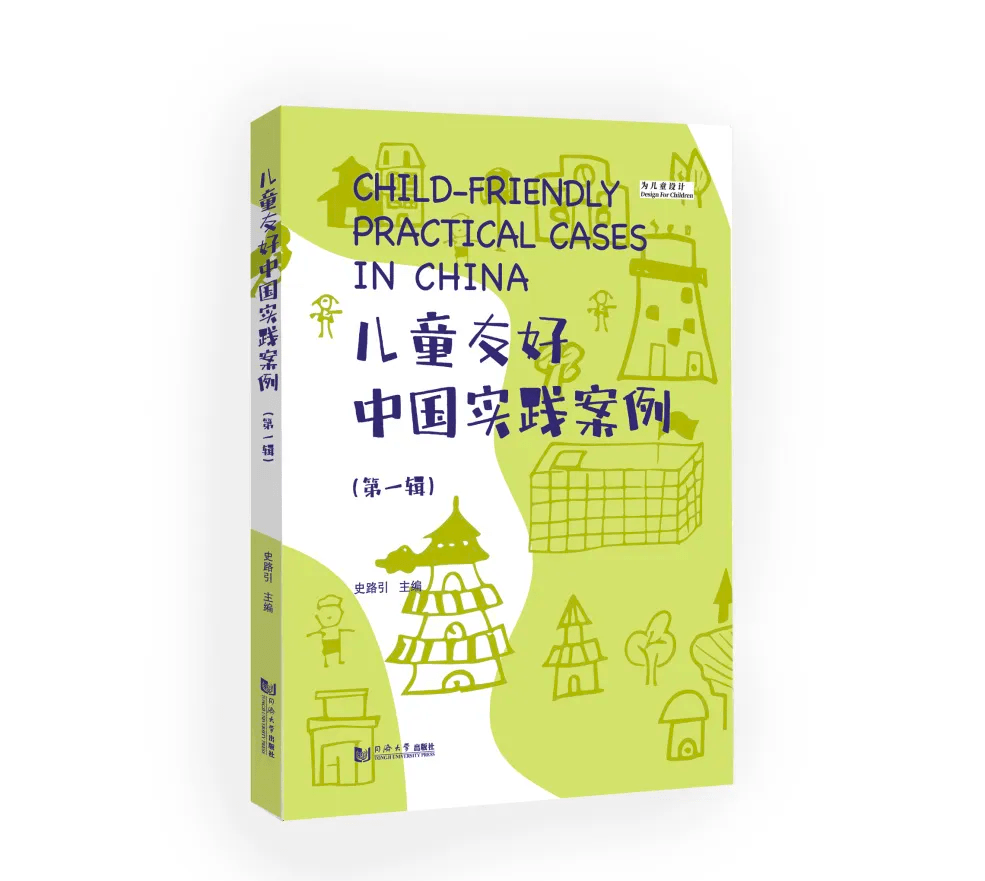
ISBN: 978-7-5765-0978-6
Tongji University Press
The cases included in this volume cover diverse areas, such as neighborhoods, communities, schools, hospitals, and parks. They are exemplary, innovative, and of high practical significance, demonstrating successful approaches to implementing child-friendly practices across various domains.
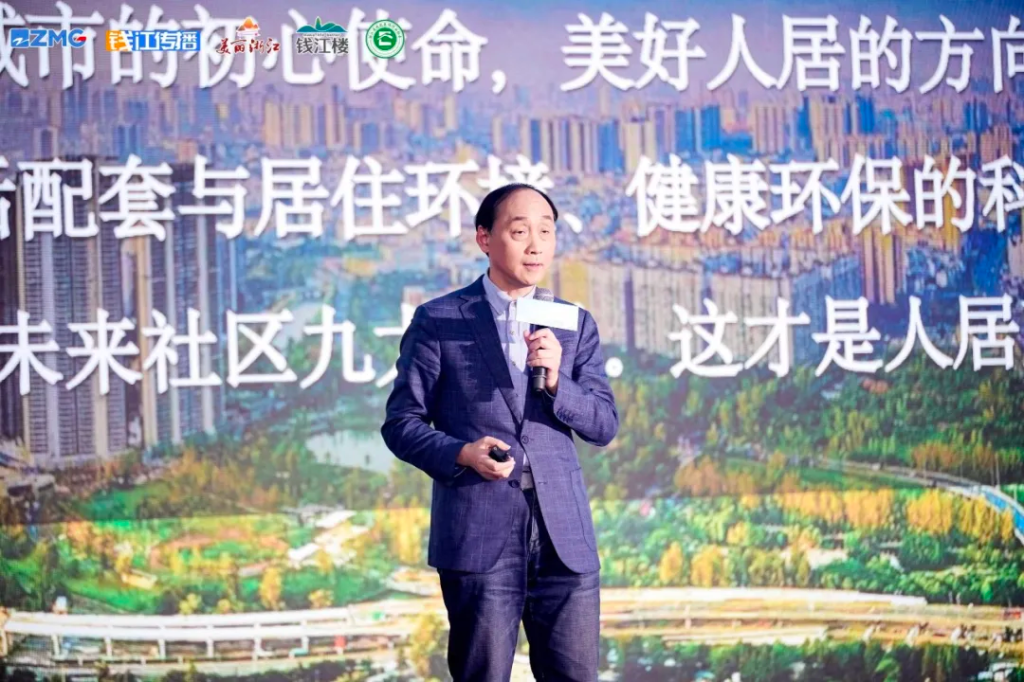
I met Shi Luyin through urban cultural exchange activities in Hangzhou. Since 2021, he has developed a deep interest in child-friendly initiatives, personally engaging in the promotion of child-friendly city concepts, think tank research, and work to empower child-friendly practices. With my background in urban planning, he earnestly invited me to write the foreword for Child-Friendly Practical Cases in China (Volume One), which he edited. Though I felt my abilities might be limited and was somewhat apprehensive, considering that this would be a contribution to the “flowers” of our country—our children—I felt it my duty and agreed with delight.
The Western philosopher Aristotle once remarked, “People come to cities to live, but they stay to live better.” Cities are containers of human life, homes that facilitate the pursuit of happiness. The fundamental difference between urban and rural areas is that cities offer more complete public services. As the 2010 Shanghai World Expo slogan suggested: “Better City, Better Life!” However, this vision has gone through a complex transformation throughout China’s urban development.
For instance, when New China was founded, Hangzhou was a consumption-based city, aiming to become an “Eastern Geneva”—a garden city adorned with lush greenery and natural beauty. However, in 1957, the national agenda shifted towards rapid industrialization to strengthen the country’s weak industrial base. This meant curtailing investment in housing, consumption, and public services to prioritize industrial development. Hangzhou, therefore, transformed from a consumption-oriented city into a production-focused one, shifting from a scenic destination to an industrial city. This pivot turned the city into a “machine for production,” while the concurrent ideological critique of bourgeois lifestyles further restrained consumer habits. Urban planning consequently paid little attention to the needs of daily life and relevant facilities—let alone investing resources in spaces and amenities designed for children.
Since the reform and opening-up, China’s rapid socio-economic growth has prompted extensive infrastructure development and the creation of development zones, accelerating urban expansion. This urbanization has, in turn, facilitated industrialization, resulting in a positive cycle of “industrial-urban synergy.” Governments began to recognize that enhancing urban services could further boost industrial growth, promoting a shift from “separate industry and city” to “integrated industry and city,” and from development zones to new industrial cities.
In the early 21st century, Hangzhou coined the slogan, “Live in Hangzhou, Learn in Hangzhou, Tour in Hangzhou, Start a Business in Hangzhou,” marking the first shift of the city’s focus from production to the quality of life. From 2007 to 2008, the city further established its identity as “A City of Quality Life,” aiming to build a high-quality city comparable to the world’s most renowned, with contributions from all and benefits shared by all. Consequently, Hangzhou undertook comprehensive environmental enhancements, emphasizing the construction of public facilities like residential areas, commercial complexes, hospitals, schools, and cultural and sports centers, as well as setting standards for basic public service facilities.
By 2010, the population of residents aged 60 and above in Hangzhou reached 13.40%, and those aged 65 and above made up 9.02%, marking the city’s entry into an aging society. In response, in 2012, Hangzhou launched initiatives to build “elderly-friendly cities” and “elderly-friendly communities” to address the challenges of an aging demographic. After 2018, efforts to renovate older neighborhoods and build future communities emphasized the configuration of services for both the elderly and children.
Since 2015, Hangzhou has seen rapid population growth, with an annual increase exceeding 100,000 people and peaking at 554,000 in 2019. Although growth has slowed in recent years, the population still increased by 172,000 in 2022. This surge has led to significant imbalances and inadequacies in the supply of public services such as education, healthcare, culture, and sports, revealing a need to fill these gaps. Meanwhile, in 2022, China experienced its first population decline in 61 years, with a reduction of 850,000 people compared to the end of 2021. Thus, population development now faces dual pressures of aging and declining birth rates. Against this backdrop, and following the notice issued by the National Development and Reform Commission and the Office of the State Council Working Committee on Women and Children on launching the first batch of pilot programs for child-friendly city construction (December 2021), Hangzhou began its efforts to build a child-friendly city. This represents another critical initiative following the city’s shift toward a “city of quality life,” aimed at addressing the dual challenges of an aging society and a declining birthrate.
Children are the “flowers” of our nation and the hope for China’s future. Constructing child-friendly cities is critical for children’s healthy growth and future development, enhancing women’s willingness to have children, and increasing a city’s ability to attract and retain residents. It is both important and urgent, embodying the people’s aspirations for a better life and representing a major initiative to safeguard children’s rights to survival, development, protection, and participation. Therefore, at the macro level, full recognition and emphasis are needed, while at the micro level, more attention should be given to regulation and design to ensure the effective implementation of this work.
From an urban planning perspective, the concept of “seeing the city from a height of one meter” provides a genuine child’s-eye view. This user-oriented perspective helps us move beyond adult-centric views and consider safety, health, convenience, comfort, greenery, intelligence, and fairness from the perspective of a child’s living environment and needs. Such an approach enables us to establish precise standards for child-friendly facilities, design spaces conducive to child development, and improve the overall quality of their living environment. It is a concrete manifestation of a people-centered approach in the realm of child development and an important step to enhance the public’s sense of fulfillment, safety, and happiness.
Reflecting on my own childhood, I used to walk to school on my own, and my parents never once had to accompany me. Today, however, with the heavy traffic and the dangers of crossing roads, most children need their parents to drop them off. Back then, even though there were no designated play facilities for children, we could spend hours playing in a roadside sandpit; yet today, many residential areas are spotless but lack spaces for children to play. These pain points emphasize the need to build child-friendly cities and address issues at different levels—city, neighborhood, and community. For instance, the recent “Future Community” initiative proposes solutions like “Worry-Free Routes to School” to address children’s commuting needs.
Urban facilities for children play a crucial role in their development. Reflecting on my own experiences, I was fortunate as a primary school student to serve as a part-time librarian at the Hangzhou Children’s Palace Library, exploring every corner of the palace and opening the door to knowledge. Later, I was also lucky to join a radio interest class, where I learned from Mr. Qiu Dachang and acquired an early understanding of physics, broadening my horizons. Such spaces for children’s activities offer essential channels for gaining knowledge and are indispensable infrastructure for child development.
The role of children in social participation should also not be overlooked. When I was young, my residential building shared a single utility meter, and each month the children were responsible for recording the readings. The process of going door-to-door not only allowed children to meet neighbors but also provided practical exercises in math by calculating costs. Today, many communities organize “Neighbor’s Day” events, with children acting as a bridge to foster closer ties among residents and promote harmonious and supportive neighborly relations.
This book presents outstanding cases of child-friendly city construction across China, from various perspectives including child-friendly neighborhoods, communities, schools, hospitals, parks, venues, public welfare activities, participation, and enterprises. It offers readers fresh ideas and new approaches for building child-friendly cities and will undoubtedly contribute to accelerating the development of such cities across China.
As highlighted in this book, the principles and requirements of child-friendly cities must be integrated into urban development and land-use planning to build a societal consensus, guide work across all departments, and secure support in terms of project funding, land allocation, and policy. Child-friendly city construction is a “cross-domain, cross-department, cross-discipline, cross-industry, and cross-generational” collaborative endeavor. Its effective realization requires cooperation among government, society, and parents. Special emphasis must be placed on involving children as active participants, ensuring that decisions made truly reflect their needs. The first steps in advancing this work include policy guidance, concept dissemination, and the establishment of pilot sites, while also establishing sustainable paths to ensure that child-friendly city construction benefits all of society. Only when broader groups and stakeholders embrace these practices can the full significance of this work be realized.
It is also worth noting that building child-friendly cities, like constructing elderly-friendly cities, is a significant measure to respond to the challenges posed by demographic shifts. There are areas of overlap and mutual benefit between the two. For example, newly built childcare facilities to accommodate the recent surge in young children can later be repurposed as elderly care facilities once the peak in demand for daycare has passed. Co-locating childcare and elderly care facilities also encourages older adults to participate in daycare activities, promoting their physical health.
In conclusion, building child-friendly cities is a livelihood project that benefits both current and future generations. It requires the participation of more insightful individuals to promote its progress. Let us take the publication of this book as an opportunity to sow the seeds of child-friendly cities far and wide, allowing the flowers of child-friendly cities to bloom across the country, and enabling every child to share in the benefits of child-friendly city development and grow up happily.
Tang Hairu
July 2023

 CCFU2089