In recent years, China has been actively advancing the development of child-friendly cities. The National Development and Reform Commission aims to establish 100 pilot child-friendly cities across the country by 2025. This initiative seeks to integrate child-friendly principles into the core of social policies, public services, rights protection, spaces for growth, and overall development environments. With Wuxi City being selected in 2022 as part of the second batch of national child-friendly cities, the municipal party committee and government have emphasized the importance of this effort, explicitly proposing the creation of a new model of a child-friendly city that reflects Wuxi’s unique characteristics and contemporary relevance. In recent years, government work reports have positioned the pilot program for child-friendly city development as a significant measure for enhancing public welfare. For the first time, projects such as the “completion of 16 child-friendly parks” were included in the 2022 agenda of practical initiatives for public benefit. Furthermore, major public welfare projects, including the Zoological Park, Botanical Garden, the “Liangxi River Ten Mile Gallery” landscape belt, the Lihu Lake scenic area, and the Canal Park area, have been actively promoted and developed.
1 Background on Child Friendliness
1.1 Child-Friendly Cities
In 1992, the United Nations introduced the concept of the Child-Friendly City (CFC) as part of the “Mayors as Defenders of Children” movement. By 1996, the United Nations Foundation officially launched the “Child-Friendly Cities Initiative” (CFCI), promoting urban planning and management that prioritize children’s needs and create an environment conducive to their development. In 2021, China’s 14th Five-Year Plan identified the development of “child-friendly cities” as a major national project, setting forth the goal of establishing 100 model child-friendly cities.
1.2 Child-Friendly Parks
Child-friendly parks are designed with careful consideration of children’s psychological and physical needs. By integrating the park’s functional areas and natural characteristics, these parks adapt to local conditions to provide safe public spaces for children. They are thoughtfully equipped with amenities that cater to the diverse needs of children across different age groups.
1.3 Common Issues
The theoretical framework for child-friendliness in China has developed relatively late and often relies on the synthesis of international research findings. Currently, a prevalent issue in domestic park design is an adult-oriented focus, with spaces for children’s activities typically restricted to designated areas within the park [1]. These areas usually feature single-function equipment with little thematic design and are primarily geared towards younger children, leading to low engagement from older children and a limited reflection of an overarching child-friendly approach. Additionally, safety considerations for children in parks are often insufficient. For instance, steep slopes and deep water features pose injury risks for children playing independently; landscape installations and play equipment often have conventional designs lacking in appeal for children; sharp edges on facilities can cause injury; and child-specific wayfinding systems and warning signs are generally absent.
2 Overview of the “Liangxi River Ten-Mile Gallery”
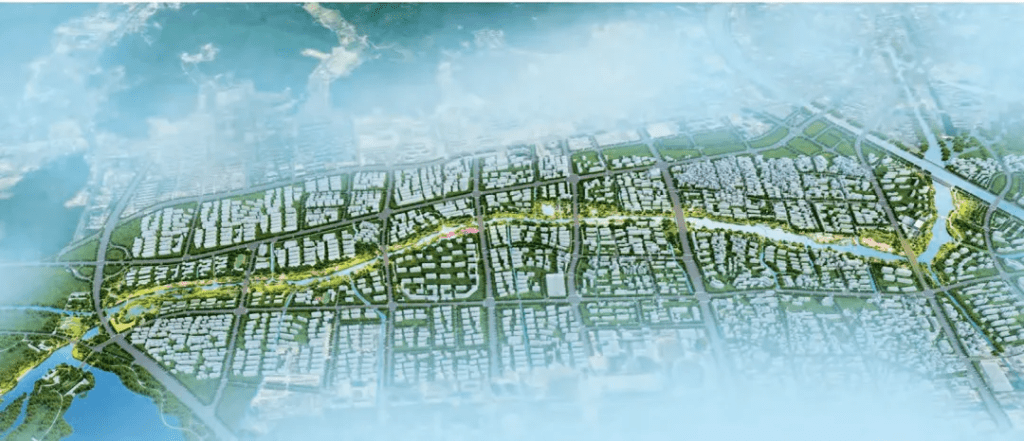
The Liangxi River, also known as Liangqing Creek, is located in the southeastern part of Wuxi City, connecting to Lihu Lake in the west and linking to the Grand Canal and the city’s internal water network in the east. As Wuxi’s oldest natural river, the Liangxi River is affectionately referred to as the “Mother River” by its residents. The “Liangxi River Ten-Mile Gallery” is a landscape improvement and enhancement project, marking the first major initiative in Wuxi’s Beautiful Rivers and Lakes construction plan. Launched in April 2022, the project extends from Daxuan Bridge on Huanhu Road in the west to Yunhe West Road in the east, spanning approximately 6.5 kilometers, with a land area of about 820,000 square meters and a total investment of around 730 million yuan. The entire landscape corridor was completed and officially opened to the public in September 2023.
The Liangxi River’s redevelopment adopts urban renewal strategies to incorporate child-friendly design principles, sponge city concepts, and low-carbon, environmentally conscious approaches. The aim is to construct an all-age-friendly, accessible space that aligns with public interests, ultimately transforming the Liangxi River into a “river of beauty,” “river of the people,” and “river of charm,” and establishing it as a model for the “Happy Garden” brand in Jiangsu Province.
The 13-kilometer landscape belt along the Liangxi River is surrounded by several schools, including Hezhe Middle School, Liyuan Central Primary School, and Shuixiu Kindergarten, as well as over 20 residential communities. This results in a high concentration of educational resources and children. Consequently, the project emphasizes child-friendliness as a core design philosophy, carefully crafting a model for child-friendly park development.
3 Planning of Child-Friendly Spaces
3.1 Overall Layout
The Liangxi River spans a long distance, with broad landscape areas on both banks. The project’s overall planning coordinates child-friendly spaces across three levels—community, neighborhood, and city—focusing on the child-friendly adaptation of public service facilities, road spaces, and park green areas. In practice, a range of measures are employed to adapt spaces frequently used by children, categorized as nodes, pathways, and areas, to create a safe, comfortable, friendly, and playful child-adapted urban waterfront. Area spaces are characterized by a comprehensive child-friendly design standard, encompassing features such as child-friendly signage, accessible facilities, seating areas, paving, and greenery. Pathway spaces are developed in line with children’s daily routes to school and play, establishing child-friendly paths and dedicated traffic systems, including school walkways, parent waiting zones, and brightly colored crosswalks. Node spaces are tailored activity areas designed to cater to the needs of children from different age groups.
3.2 Featured Nodes
The schools along the Liangxi River are mainly clustered in the region west of Hongqiao. Therefore, child-friendly spaces are strategically located around residential communities and school zones where children gather frequently. For safety reasons, segments of the south bank with high-voltage corridors were excluded from development. Additionally, selected child-friendly spaces were designed in harmony with existing site features, optimizing and repurposing current landscapes and structures to minimize construction costs.
The “Luo Ying Playground” (Early Childhood Activity Area for ages 2–6), situated at Shuixiu Kindergarten, is inspired by the puzzle games favored by children in this age group. Enlarged puzzle patterns are embedded into the ground mats, and combined with playful slides, LEGO blocks, and other educational game elements, the playground offers a multidimensional space where young children can play freely after school.
The “Hongqiao Parent-Child Garden” (All-Age Activity Area for ages 2–12) is themed around space exploration. Given the limited natural light beneath the bridge, soft materials are used to partition the space safely. The space is brought to life with elements like tunnels, climbing structures, spinning bowls, and rotating seats, simulating a space-themed environment.
Adjacent to Liyuan Central Primary School, the “Shady Activity Node” (All-Age Activity Area for ages 2–12) uses natural wooden play structures and benches, integrating seamlessly with the existing woodland to create a rustic, nature-inspired setting. The ground retains an unpaved, earthy surface, and the existing sloped terrain is modified to include varied elevations, sparking children’s curiosity and desire to explore the natural environment.
The “Magic Cube Playground” at Hezhe Middle School (Youth Activity Area for ages 12–18) features interactive installations themed around the magic cube, inviting users to engage with and reshape the space. This creates a unique combination of “interaction + art + sculpture,” blending recreational play with artistic expression. The result is an integration of art and play, energizing the leisure activities of young students. The nearby multi-functional library provides an additional comfortable space for students to relax, equipped with practical amenities like drinking fountains.
4 Key Elements in Creating Child-Friendly Spaces
4.1 Principles of Creation
Three principles guide the creation of child-friendly spaces: safety first, child-centered; adaptation to local conditions with age-appropriate design; and a return to nature that encourages learning through play.
1. Safety First, Child-Centered. Child-friendly urban parks should prioritize safety and children’s needs, focusing on aspects like traffic organization and space design. In the construction of the Liangxi River spaces, safe, green, and environmentally friendly materials were used, with rounded edges for wood and metal components. The design of seating and wash basins is tailored to the heights and usage requirements of children.
2. Adapting to Local Conditions, Age-Based Design. Child-friendly spaces should be tailored to children’s preferences and parental supervision needs, categorizing spaces into four levels:
• High supervision (0–3 years): Fully enclosed areas for infants requiring close parental care, ensuring a 360° view for supervision.
• Moderate supervision (3–6 years): Semi-enclosed spaces with clear sightlines, designed to encourage creativity with features like sandpits, swings, and slides. An example is the Luo Ying Playground near Shuixiu Kindergarten.
• Low supervision (6–12 years): Spaces allowing more independence, with activities at a distance from supervision areas to encourage exploration. Facilities like skateboarding, roller-skating, badminton, and ball sports are provided, as seen in the Hongqiao Parent-Child Garden.
• No supervision (12–18 years): Spaces for adolescents to engage in self-guided activities without parental oversight. These areas feature fitness equipment and safety features like fencing, as exemplified by the Magic Cube Playground at Hezhe Middle School.
3. Returning to Nature, Education through Play. Design spaces that reflect children’s natural curiosity, integrating elements of nature, art, and playfulness. Retaining the natural environment of the Liangxi River, materials like sand, grass, and soil, along with varied terrains, enhance children’s connection to nature while ensuring safety.
4.2 Key Design Elements in Specific Areas
Key design elements for creating child-friendly spaces include terrain, water features, plants, rest facilities, small landscape structures, paving, and pathways.
1. Terrain. Varied topography provides opportunities for exploration and challenge. In the Liangxi River, slopes are designed for play, with tunnels, hills, and slides. The terrain is used to partition and enclose spaces, with windbreaks planted to regulate the microclimate of play areas.
2. Water Features. Safe, accessible natural water features are integrated into play areas. Pebble beaches, sandy shores, and lawns form interactive water zones, with clear safety buffers and signage. Sponge demonstration areas, artificial streams, fountains, and interactive water installations enhance playfulness.
3) Plants. Plant selection prioritizes safety and fun, avoiding species that are toxic, thorny, allergenic, or pest-prone. Plants with bright colors, unique forms, and changes over time are chosen for interest. Trees provide shade, hedges enclose spaces, and open areas feature high-branching ornamental plants, with durable grass for high-use lawns.
4) Rest Facilities and Small Structures. Rest facilities like seating use curved shapes with rounded edges to prevent injury, scaled for younger children. Decorative structures enhance play spaces, spark imagination, and offer educational value. Smooth surfaces and playful designs add appeal.
5) Paving and Pathways. Colorful paving is used along pathways and play areas, enhancing visual recognition and playfulness. Steps and steep slopes are minimized; where necessary, steps are kept below 12 cm in height and use double-height railings, ensuring accessibility for children.
5 Summary of Experience
5.1 Problem Identification and Solutions
The demonstration section of the Liangxi River was completed in September 2022 and opened to the public. Initial feedback indicated that certain aspects did not fully align with child-friendly space standards. After suggestions from various stakeholders and timely adjustments by the construction team, these issues were resolved in the full development of the “Liangxi River Ten-Mile Gallery.” Some key issues and solutions that may benefit other child-friendly projects are as follows:
1. At some steps, the lack of distinct paving materials and colors made it difficult to differentiate step edges in low-light conditions, leading to potential safety hazards. Clear warning signs were added to improve visibility.
2. The sponge demonstration area and piano-themed surfacing were made of smooth glass, which lacked anti-slip treatment and presented a slipping risk. Warning signs were later placed around these areas to enhance safety.
3. Many tree pits, flower beds, and benches originally had sharp edges, posing a risk to children and the elderly. Rounded edges were added to these features to mitigate safety concerns.
4. Horizontal cable guardrails were used initially, allowing children and visitors to climb on them, creating a safety issue. These guardrails were replaced with vertical structures to prevent climbing.
5.2 Strengthening Child Participation
The right to participation is one of the core principles outlined in the United Nations Convention on the Rights of the Child, which empowers children to express their views and engage in decision-making, fostering their active role in social development. In designing child-friendly spaces, it is important to enhance child participation by involving government, communities, schools, and parents to ensure inclusive design processes. Children’s ideas and feedback should be actively sought to ensure their needs are genuinely reflected in the design. During the redevelopment of the “Liangxi River Ten-Mile Gallery,” representatives from Hezhe Middle School, Liyuan Primary School, and Shuixiu Experimental Kindergarten were invited to provide input on landscape design, plant selection, play facilities, and extracurricular activity spaces. Additionally, local students were encouraged to paint “urban impressions” murals on manhole covers, fences, and other structures, fostering a sense of ownership and allowing them to actively participate in shaping their city’s development.
6 Conclusion
In recent years, China has increasingly emphasized the development of child-friendly cities, with many major cities actively pursuing urban space designs that focus on children’s needs. Parks, as a vital part of urban open spaces, play a key role in these efforts. This paper examines the “Liangxi River Ten-Mile Gallery” project as a case study, aiming to provide insights for the development of child-friendly park spaces. The design of such spaces should adhere to key principles, including safety as a top priority, rational zoning, and incorporating elements of natural playfulness.
In summary, the approach should emphasize a return to nature with subtle, integrated design; apply zoning to improve safety and facilitate ongoing maintenance and management; and encourage active participation from children to promote shared creation. This will allow urban parks to fully realize their potential as child-friendly spaces.
 CCFU2089