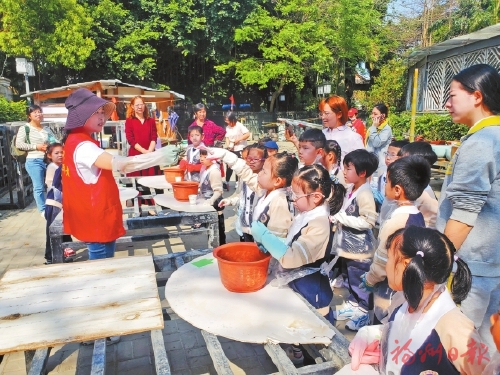
Recently, the Social Development Department of the National Development and Reform Commission and the Office of the State Council’s Working Committee on Women and Children jointly hosted the 2024 Child-Friendly City Development Exchange and Training Program in Wuxi, Jiangsu Province. The Fuzhou Women’s Federation was invited to attend and, as a city representative, shared insights from Fuzhou’s approach. So, what makes the “Fuzhou Model” stand out in nationwide efforts to create child-friendly cities? The answer lies in fostering a cultural brand that nurtures childhood.
Embracing Heritage to Sustain Cultural Roots
Fourth-grader Zhang Yuanxi from Gulou No.1 Primary School serves as a “Red Scarf” youth guide at the Yan Fu Former Residence. On weekends and holidays, she welcomes visitors from across the country, sharing stories of the celebrated scholar Yan Fu. Her dedication won her first place in the primary school division at the first provincial Red Scarf Youth Guide Competition this year. Fuzhou currently has over 220,000 registered “Red Scarf” youth guides. This summer alone, the guides in Gulou District, where the famous Three Lanes and Seven Alleys are located, conducted more than 600 volunteer sessions, serving nearly 100,000 visitors.
“In building a child-friendly city, we strive to create an environment where children can feel close to, explore, and integrate with our culture,” said a Fuzhou Women’s Federation official. “Providing platforms for ‘Red Scarf’ guides is an effective way to sustain our cultural heritage.”
Fuzhou also launched a public art education initiative, the “Art for All—Children’s Education Enhancement Program,” enlisting local culture centers, art groups, folk art practitioners, and teachers as volunteers. The program has partnered with qualified social organizations to set up training bases. As of June this year, the program has established over 60 off-site training bases and 165 traditional culture demonstration sites, providing more than 6,000 hours of free courses and workshops annually.
Bridging Cultures: Deepening Ties Between Children in Fujian and Taiwan
Wang Mengxin, a mother from Jinan District’s Guixi Community, and her husband, both returned from studying abroad, founded a community-based reading program called “Mom’s Storytime.” Through this program, their son Miaomiao became close friends with a younger girl from Taiwan, nicknamed Gua Gua. Every year on Gua Gua’s birthday, Miaomiao gifts her a small bag filled with thoughtful items, which he says represents his hope to bring her joy and “cure all worries.” As a community with a large number of Taiwan residents, Guixi Community offers events such as public reading sessions and traditional festivals, allowing children to bond and form lasting friendships.
With initiatives like the Fuma “Twin-City Life Circle” and Fuzhou’s role as a demonstration area for integrated cross-Strait development, the city has been strengthening connections between youth from Fujian and Taiwan. It has established venues like the Cross-Strait Youth Exchange Camp and the Cross-Strait Community Exchange Center, organizing events such as the Cross-Strait Nursery Rhyme Festival, the Cross-Strait Youth Dream Tour, and other joint activities to foster lasting friendships.
“Fuzhou is one of the first cities in the country to complete a full rugby team lineup spanning preschool, primary, and higher education levels, with over 60 schools regularly offering rugby programs,” noted an official from the Fuzhou Women’s and Children’s Working Committee Office. “The 2024 Cross-Strait Youth Rugby Exchange Games even included a preschool group, marking the largest cross-Strait rugby event to date.”
Expanding Accessibility to Cultural Services
Young residents like Keke from Yangtoukhou Community in Chating Subdistrict, Taijiang District, often spend their days in Chating Park, which has a lotus education base where children can observe the growth of lotus flowers and learn about filial piety and honesty. According to Lin Zhi, secretary of the Yangtoukhou Community Party Committee, the community recently enhanced child-friendly facilities in the park, adding a 40-square-meter children’s play area and opening the lotus nursery in March to attract young learners.
“Yangtoukhou Community was among the first to undergo assessment as a child-friendly community. Their integration of ‘Lotus Culture’ and ‘Filial Piety Culture’ in child-friendly spaces and third-party campaigns promoting traditional values has been a key feature,” said an official from the Fuzhou Women’s and Children’s Working Committee Office.
Fuzhou continues to implement projects such as “Little Banyan Tree Views the City,” creating a team of young “Junior Observers” throughout the city, encouraging children to participate in and experience urban cultural life. Emphasizing the use of digital technology in cultural activities, the city has introduced digital storytelling experiences in cultural heritage areas like Luozhou Ancient Town. Through AR technology, children engage in interactive “mystery hunts,” uncovering the rich history of locations such as Luozhou, Linpu, Yangqi, and Yantai Mountain, which fosters a deep-rooted appreciation for traditional culture among the young generation.
 CCFU2089